What Makes a Great Dealership Profitability Consulting Partner? 7 Criteria and the Numbers That Prove Each One
A great dealership profitability consulting partner shows up in the store, installs a documented process, sets numeric targets on day one, and reports against them every month. Vision Management Group uses the seven criteria below to judge its own engagements. Each one comes with a question to ask, evidence to request, and a number you can check, whether you are hiring a firm or reviewing one you already pay.
The Dealership Consulting Partner Scorecard
Use this table before you sign, and again twelve months in.
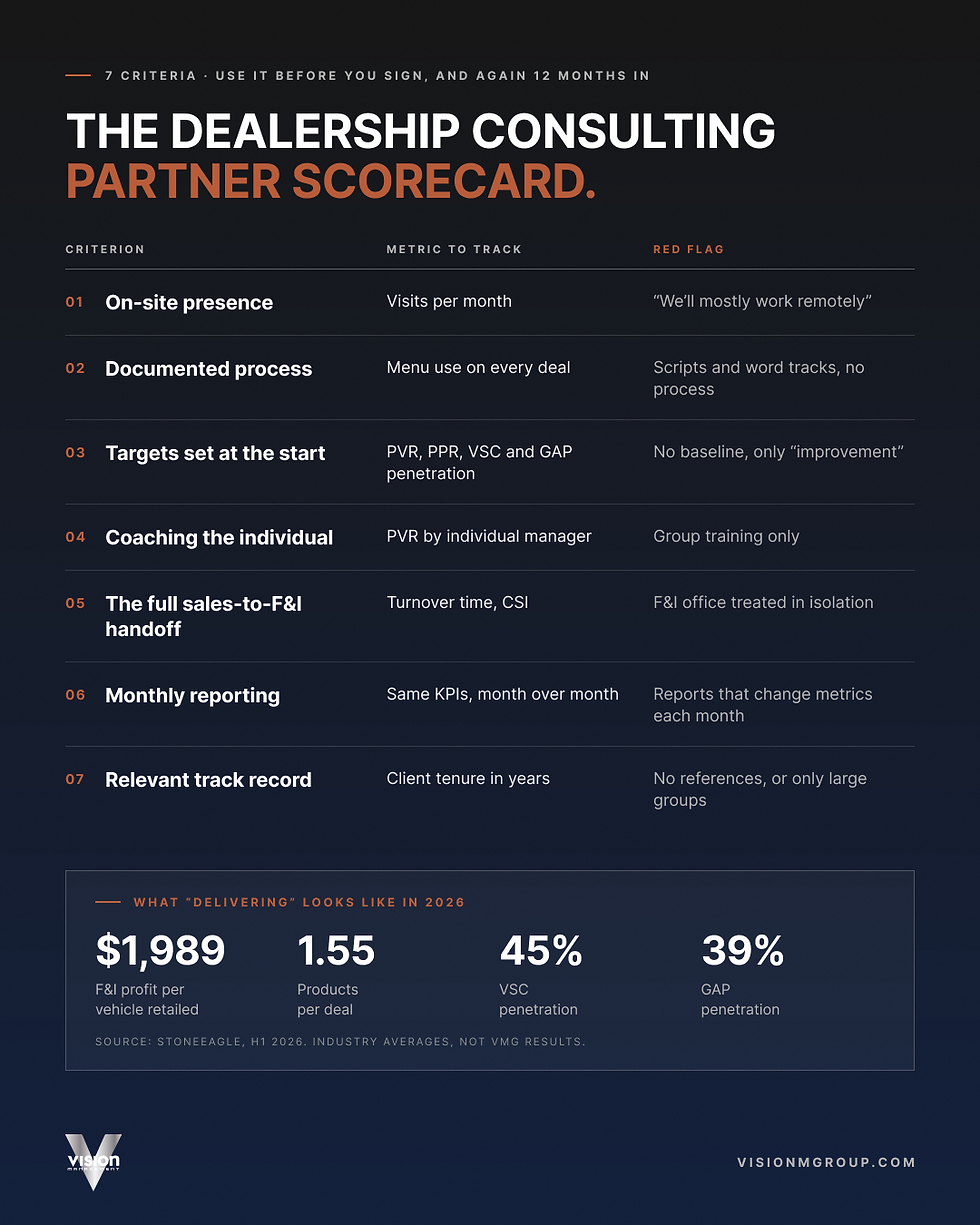
Criterion | What to ask | Evidence to request | Metric to track | Red flag |
1. On-site presence | How often is a coach physically in our store? | A visit calendar for the first 90 days | Visits per month | "We'll mostly work remotely" |
2. Documented process | What exactly will our F&I managers do differently? | The written menu process and sample presentation | Menu use on every deal | Scripts and word tracks, no process |
3. Targets set at the start | What baseline will you measure against? | A baseline pulled from our DMS in week one | PVR, PPR, VSC and GAP penetration | No baseline, only "improvement" |
4. Coaching the individual | Who coaches each business manager, and how often? | A one-on-one coaching schedule per manager | PVR by individual manager | Group training only |
5. The full sales-to-F&I handoff | Do you work with the sales desk, or only F&I? | Notes from sales and desk sessions | Turnover time, CSI | F&I office treated in isolation |
6. Monthly reporting | What will we see every month? | A sample monthly report | Same KPIs, month over month | Reports that change metrics each month |
7. Relevant track record | Which stores like ours have you worked with, and for how long? | Named references of similar size and type | Client tenure in years | No references, or only large groups |
1. On-Site Presence, Not Remote Advice
Process changes happen on the showroom floor and in the F&I office, not in a monthly call. A consulting partner should be in your store often enough to watch live deals and correct habits before they settle. Ask for a visit calendar and hold the firm to it.
At Hilltop Camper and RV, VMG reps are in the store nearly once a week for guidance, role-playing, and product training. The store's finance income more than doubled.
2. A Documented, Repeatable Process
A great partner can hand you the process in writing. If the method only lives in the consultant's head, it leaves when they do. Look for a structured menu presentation that every manager runs the same way on every deal, which is also what keeps compliance consistent.
VMG's 7-Minute Menu process establishes loan context before products are presented and uses phrases instead of memorized word tracks. Structured menus move stores toward 2.76 products per deal, against roughly 1.26 for unstructured presentations and an industry average of 1.55 (how products per deal drives PVR).
3. Numeric Targets Set at the Start
A consultant who cannot tell you your starting point cannot show you what changed. In the first week, the firm should pull PVR, PPR, and product-level penetration from your DMS and agree targets with you in writing. Every later report should measure against those same numbers.
If a firm offers a revenue guarantee or other risk-sharing, get the terms tied to that baseline. A guarantee without a written baseline cannot be enforced.
4. Coaching the Individual, Not Just the Department
Two business managers in the same store, with the same products and the same customers, can produce very different PVR. Department-wide training rarely closes that gap. A great partner coaches each manager one-on-one, reviews that manager's own deals, and tracks that manager's numbers.
VMG runs this through Solo Sessions: one-on-one coaching where the coach reviews deals, role-plays objections, and sets action items between sessions. One business manager raised CPVR from $147 to $1,102 through this coaching.
5. The Full Sales-to-F&I Handoff
Many F&I problems start before the customer reaches the F&I office. A rough turnover from the desk costs products, time, and CSI. A good partner works with sales managers and the desk as well as the F&I team.
At Harry Brown's Family Automotive, VMG's team found a disconnect between the desk and F&I that the store had not seen from the inside. At Northtown Automotive in Yankton, South Dakota, VMG rebuilt the sales-to-finance handoff during a reset visit, and the F&I department grossed more than $1.4 million in its first nine months with VMG (full Northtown story).
6. Transparent Monthly Reporting
Monthly reports should show the same KPIs every month, against the baseline from criterion 3. PVR, PPR, and VSC and GAP penetration are the minimum, broken out by manager. If the metrics in the report keep changing, the firm is choosing what to show you.
This is also where you catch problems early. A partner who reports the same numbers every month gives you a clear signal when something slips.
7. A Track Record With Dealerships Like Yours
Ask for references from stores of your size, franchise or RV mix, and market type, then call them. Tenure is one of the most useful signals, because dealers do not keep paying a consultant for years unless the results hold.
Lockwood Motors and Sharp Automotive have each worked with VMG for more than ten years. Over that time, Sharp Automotive grew from 100 units per month to more than 150.
What "Delivering" Looks Like in 2026: F&I Benchmarks
Use these benchmarks to judge whether a partner's results are strong, average, or weak. Compare against the same period and store type where you can.
Metric | Benchmark | Source |
F&I profit per vehicle retailed | $1,989 | |
F&I income per retail unit (franchised dealers) | $1,769 | |
F&I gross per vehicle, public dealer groups | $2,534 | |
Products per deal | 1.55 | |
VSC penetration | 45% | |
GAP penetration | 39% |
The PVR figures differ because each dataset measures a different group of dealers. For a full walkthrough of calculating your own PVR, see What Is PVR in Car Sales?
How Vision Management Group Measures Against These Seven Criteria
Vision Management Group was founded in 1999 and works on-site with automotive and RV dealerships nationally (more on VMG). Against this scorecard, VMG coaches visit stores as often as weekly (criterion 1), every engagement runs on the 7-Minute Menu (criterion 2), and baselines come from a free Dealer Health Check-up before work begins (criterion 3). Solo Sessions cover criterion 4, and VMG's six-step system covers the handoff and monthly reviews (VMG's six-step system).
For criterion 7, VMG's longest relationships run past ten years. One honest gap: VMG does not yet publish portfolio-wide averages across all clients. The results above are individual, named engagements.
For help deciding what kind of partner to hire in the first place, see Who Should You Hire to Fix F&I Profitability? For a broader overview of dealership consulting services, including types of engagements and how they are structured, see VMG's consulting guide.
Frequently Asked Questions
How do I know if my dealership consultant is delivering results?
Compare your current PVR, products per deal, and VSC and GAP penetration against the baseline pulled when the engagement started. A consultant who is delivering should show steady movement in those numbers, broken out by manager, in the same monthly report format every month.
What metrics should a dealership consultant track?
At minimum, a dealership consultant working on F&I should track PVR, products per deal (PPR), and product-level penetration for VSC and GAP, broken out by individual business manager. Turnover time from sales to F&I and CSI are useful secondary measures.
How long should it take to see results from a consulting partner?
Many dealerships see measurable change within the first several months. At Northtown Automotive, a business manager hired the day before VMG's reset visit grossed more than the store's other two business managers combined in his first four months.
What is a good F&I PVR in 2026?
StoneEagle reported average F&I profit of $1,989 per vehicle retailed in the first half of 2026, and Presidio-NCM reported a record $1,769 in F&I income per retail unit in Q2 2026. Publicly traded dealer groups averaged $2,534 in Q3 2025, according to Haig Partners.
What should dealership consulting services include?
Dealership consulting services for F&I should include on-site visits, a documented menu process, a baseline and written targets, one-on-one coaching for each business manager, work on the sales-to-F&I handoff, and a consistent monthly report.
Check Your Current Partner Against the Scorecard
Vision Management Group has helped 20+ automotive and RV dealerships increase F&I revenue by an average of 30%. If you want a baseline to hold any consulting partner to, including VMG, the Dealer Health Check-up gives you one.


